Princípios da Agroecologia

Agricultura sustentável tem que considerar aspectos socioeconômicos e culturais dos grupos sociais implicados. Não basta proteger e melhorar o solo ou a produtividade agrícola se não resulta em melhorias nas condições de vida das pessoas envolvidas. Portanto, agricultura sustentável é um conceito que implica aspectos políticos e ideológicos que tem a ver com o conceito de cidadania e libertação dos esquemas de dominação impostos por setores de nossa própria sociedade e por interesses econômicos de grandes grupos, de modo que não se pode abordar o tema reduzindo outra vez as questões técnicas.

Francisco Roberto Caporal

http://www.aba-agroecologia.org.br/

grãos

"Muita gente pequena, em muitos lugares pequenos, fazendo coisas pequenas, mudarão a face da Terra". provérbio africano

Como os lobos mudam rios

Como se processa os animais que comemos

Rio Banabuiu

https://youtu.be/395C33LYzOg

A VERDADE SOBRE O CANCER

https://go.thetruthaboutcancer.com/?ref=3b668440-7278-4130-8d3c-d3e9f17568c8
Mostrando postagens com marcador Direitos dos Animais. Mostrar todas as postagens

sexta-feira, 11 de abril de 2014

Banksy!

2


1


  http://vista-se.com.br/banksy-provoca-reflexao-sobre-a-morte-de-animais-para-alimentacao-com-instalacao-artistica/

Banksy provoca reflexão sobre a morte de animais para alimentação com instalação artística

Fabio Chaves
Do Vista-se
Por ser de Banksy, a ação virou pauta em dezenas de jornais pelo mundo.
O misterioso e aclamado artista britânico conhecido pelo pseudônimo de Banksy faz uma nova e poderosa crítica social, desta vez, em Nova York. Quase sempre ele utiliza o grafiti para se expressar, mas, desta vez, o artista resolveu fazer uma instalação em um caminhão que rodará as ruas do Brooklin, nos EUA, por duas semanas.
Não existem muitas informações sobre a vida pessoal de Banksy, portanto, não se sabe se ele é vegano. No entanto, a julgar por esta obra, é possível acreditar que sim. Em um caminhão velho, Banksy colocou dezenas de animais de pelúcia que se movem e emitem um som parecido com uma sirene, como um alerta. O nome da instalação é “Sirens of the lambs” (Sirenes dos cordeiros), em uma clara alusão aos gritos de socorro que os animais emitem nos matadouros – quase sempre em vão.
Banksy teve o cuidado de escolher pelúcias de animais considerados de consumo (cordeiros, vacas, galinhas, porcos etc.) e colocou um panda entre eles, para aguçar ainda mais a reflexão em quem vê o caminhão passando. A região escolhida para ação é a “Meatpacking District” (Distrito Frigorífico), que tem esse nome por ter sido ocupado por frigoríficos e fábricas de embalagens para embalar carne.
A ação tem repercutido por grandes jornais mundo afora. Alguns jornalistas tentaram falar com o motorista do caminhão, que desconversa: “Eu não sei de muita coisa, só estou dirigindo. Só estou fazendo entregas, entregando carne fresca.”, diz.
As reações são diversas. Ao avistarem o caminhão cheio de animais de brinquedo “pedindo socorro”, algumas pessoas riem e tiram fotos com o celular, outras correm e outras ficam paradas, olhando. Entre as crianças, também não há unanimidade nas reações. Enquanto algumas pulam e tentam alcançar as pelúcias, outras choram assustadas.
Assista ao vídeo da ação | Youtube | Veja também no site oficial do artista, clique aqui.


domingo, 28 de outubro de 2012

The Tragedy of Industrial Animal Factories


CAFO (Concentrated Animal Feeding Operation): The Tragedy of Industrial Animal Factories provides an unprecedented view of concentrated animal feeding operations—aka CAFOs—where increasing amounts of the world’s meat, milk, eggs, and seafood are produced. As the photos and essays in this powerful book demonstrate, the rise of the CAFO industry around the world has become one of the most pressing issues of our time. Industrial livestock production is now a leading source of climate-changing emissions, a source of both freshwater and ocean pollution, and a significant contributor to diet-related diseases such as obesity and the spread of foodborne illnesses. The intensive concentration of animals in such crammed and filthy conditions dependent on antibiotic medicines and steady streams of subsidized industrial feeds poses serious moral and ethical concerns for all of us.
Featuring more than 400 photographs and thirty essays by today’s leading thinkers on food and agriculture, including Wendell Berry, Wenonah Hauter, Fred Kirschenmann, Anna Lappé, Michael Pollan, Eric Schlosser, and Matthew Scully, CAFO takes readers on a behind-thescenes journey into the dismal world of animal factory farming. It also offers a compelling vision for a healthier food system: one that is humane, sound for farmers and communities, and safer for consumers and the environment. The book’s ultimate message is clear: We can and certainly must do better.
Along with its companion volume, The CAFO Reader, CAFO is designed to be an invaluable educational resource in the battle to reform the tragic state of animal factory farming. It will also inform and influence the growing public movement of activists, farmers, policy makers, medical professionals, and consumers who are working to make our food healthier for ourselves, for domesticated animals, and the planet.


 http://www.cafothebook.org/thebook.htm

terça-feira, 15 de maio de 2012

Filme: CHIMPANZEE


Filme: CHIMPANZEE (ainda sem tradução)
Narrador: Tim Allen
Filmado em Uganda e Costa do Marfim
Diretores: Alastair Fothergill e Mark Linfield
Um filme dos Estudos Disney


O Projeto GAP recomenda, veja o trailer: http://www.trailers.com.pt/chimpanze

Notícia relacionada:

http://www.projetogap.org.br/pt-BR/noticias/Show/3929,a-etica-do-filme-o-planeta-dos-macacos-a-origem


Fonte: 
http://www.anda.jor.br/03/05/2012/chimpanze-o-virtual-e-o-real

quinta-feira, 10 de maio de 2012

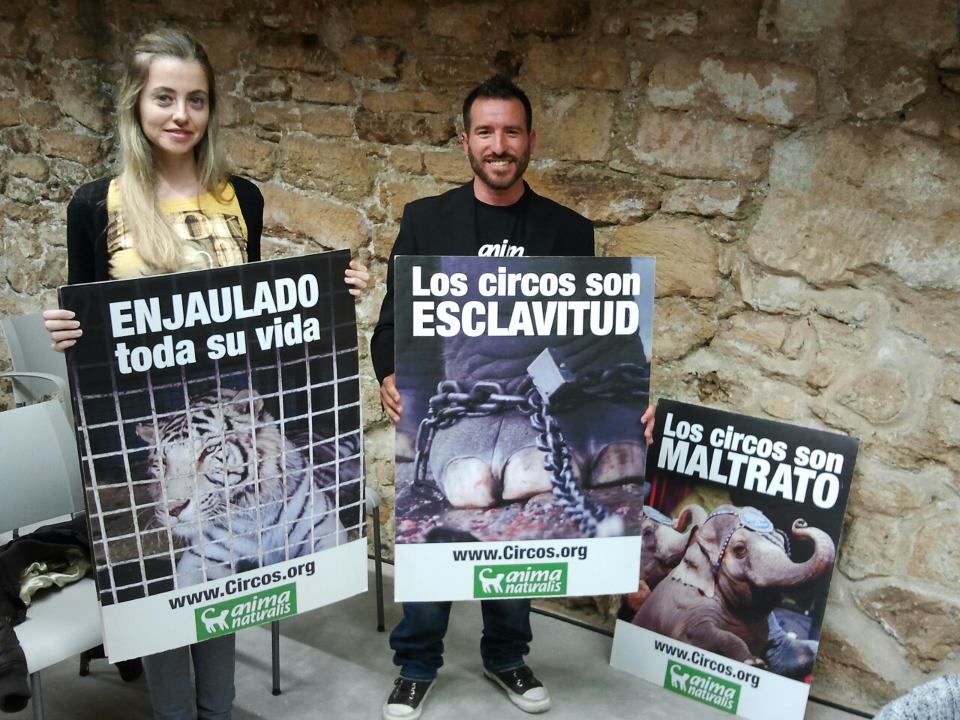
Circos sem Animais!!!!

Por unanimidad Capdepera prohibe los circos con animales de cualquier especie

España . Publicado hace 6 días.
Capdepera se convierte así en el undécimo municipio que veta los circos con animales en las Illes Balears. AnimaNaturalis
Por unanimidad Capdepera prohibe los circos con animales de cualquier especieCapdepera, España.- En la noche de ayer jueves 3 de Mayo, sobre las 23:30h., se aprobaba por unanimidad la moción presentada en Capdepera (Mallorca), para prohibir los circos que realicen espectáculos con animales. La moción fue presentada por PSM por la propuesta de AnimaNaturalis.
Durante el pleno estuvieron presentes la coordinadora de AnimaNaturalis en Mallorca, Vanesa Moreno, y el coordinador nacional de la campaña Circos Sin Animales, Ismael López. Momentos que vivieron de gran emoción al escuchar como todos los partidos políticos que gobiernan en esta localidad, dedicaron unas palabras en defensa de los animales, decidiendo entre todos, que se modificara la moción que prohibía el uso de animales salvajes, y extenderla a todos los animales. Momento en el que los dos coordinadores de AnimaNaturalis rompieron a llorar.
Capdepera se ha convertido así en el undécimo municipio de las Islas Baleares que veta los circos con animales. El primer municipio fue Esporles en 2006. Le siguió Puigpunyent en 2007, en 2010 fueron Palma, Sóller y Valldemossa, en 2011 Consell y Pollença, y en 2012 Artá, Manacor, Santa María del Camí y ahora Capdepera. Son numerosos los municipios que en toda España están tomando estas medidas de protección hacia los animales. Hay países que han tomado medidas a nivel estatal como Alemania, Grecia, Finlandia, Austria, Croacia, Suecia, Israel, Singapur, Canadá, Costa Rica, India, Peru, Bolivia, Nicaragua, China e Inglaterra a partir de julio 2012.
Desde AnimaNaturalis agradecemos y felicitamos al ayuntamiento de Capdepera por este paso en la defensa de los animales, pero muy especialmente a Pere Fuster, que ha sido la persona con la que el coordinador de la campaña Circos Sin Animales ha estado tratando la propuesta de la moción.
Si quieres saber más sobre nuestra campaña contra los circos con animales, puedes visitar nuestra página especialmente dedicada a ello: www.Circos.org

 http://www.animanaturalis.org/n/33939

sexta-feira, 13 de abril de 2012

Orfãos do Marfim!

The ivory orphans

The Sun visits sanctuary for baby elephants whose parents were killed for their valuable tusks

DAME DAPHNE SHELDRICK,PICTURED WITH HER KEEPERS AND BABY ELEPHANT MOJU 5MONTHS OLD.
Tender care ... Dame Daphne Sheldrick with Moju, the five-months-old orphaned elephant
Exclusive
Published: 11th April 2012

A GUST of red dust swirls through the air as a plane touches down on the African savannah with a badly wounded baby elephant on board.

Sun follows orphan Sities

THE Sun is supporting the Sheldrick Wildlife Trust by fostering brave little orphan Sities.
The two-year-old elephant was taken into care aged just seven weeks after losing her parents to poachers.
We will be following her progress and contributing to her upbringing as she makes her eight to ten-year journey from the nursery back into the wild elephant community of Tsavo National Park.
Little Moju, who lost her mother to poachers desperate to cash in on her valuable ivory, has arrived at Dame Daphne Sheldrick’s elephant orphanage — a sanctuary nestling in a picturesque corner of Nairobi’s National Park.
It is where Dame Daphne, 76 — knighted by the Queen in 2006 — has devoted her life to the care of elephants whose parents were killed by those hunting them for their tusks.
She lovingly rears each orphan helped by specially trained keepers until they are ready to be integrated back into the wild.
Dame Daphne said: “I have always felt privileged to live among elephants. They are far better than us humans and aren’t corrupted by greed or money.
“But I am very worried for them. Poaching is now a big problem because the growing wealth in countries like China means there is growing demand for ivory and elephants are paying the highest price of all.
“The international community must work together to make this stop before we risk losing one of the most incredible mammals known to man.

SUN REPORTER SHARON HENDRY WITH MOJU THE 3MONTH OLD BABY ELELPHANT THE SUN HAS ADOPTED AT AN ELEPHANT ORPHANAGE IN NAIROBI,KENYA.THE CHARITY IS RUN BY DAME DAPHNE SHELDRICK.MOJU IS ON A DRIP AFTER COLLAPSING DURING THE NIGHT.
Important issue ... The Sun's Sharon writes about plight of elephant orphans
“Moju is just one example. She was found all alone by rangers in Kenya’s Kora National Park. After losing her mother to poachers she had stayed alone for several days and had her tail bitten off by a pack of vicious hyenas. She is grieving terribly for her mum and will be depressed for some time.”
Africa is facing its worst elephant-poaching crisis for decades, with elephants being slaughtered illegally to meet the demand for ivory from China’s nouveau riche.
Even in one of the continent’s best-protected reserves, the Samburu National Reserve Park in northern Kenya, more elephants have been lost in the past two and a half years than in the previous 11.
During the last five months, the level of poaching has been the worst on record.
Africa had 1.3 million elephants in the 1970s but, according to the most recent estimates, now has less than 600,000.
Unbelievably, elephants are being sacrificed for decorative ornaments and “Hanko” — ivory signature seals that documents in China and Japan are traditionally stamped with.

A KEEPER GETS A KISS GOODNIGHT FROM THE BABY ELEPHANT HE SLEEPS WITH
Kiss goodnight ... little elephant gives a 'peck' to his keeper
Among upwardly mobile Chinese, such seals are on a par with owning a prestigious Mont Blanc pen.
The Sun visited Daphne’s project in Kenya to witness first-hand the effect of the re-emerging ivory trade.
The David Sheldrick Wildlife Trust was established in memory of her late husband — a well-known national park warden — in 1977.
It incorporates the Orphans' Nursery where Daphne has successfully hand-reared more than 130 young elephants, some just hours old.
Today, 12 orphans are in the tender care of the Nairobi nursery. There are a 132 that are still dependent on their keeper and milk in the two rehabilitation centres in Tsavo East National Park.
Daphne, a mum-of-two, explains her passion, adding: “My family are originally from Lincolnshire and Wales but my paternal grandfather was sent to fight in the Boer War and so we ended up migrating to Africa. I was born on a farm in the Rift Valley, in Kenya, and I grew up among orphaned animals.
“My parents thought I would be a doctor but I met and fell in love with my first husband Bill Woodley who worked in the Nairobi National Park and my life seemed destined to remain here.”

Daphne Sheldrick with first elephant
Close bond ... Dame Daphne with her first charge Aisha
Later, Daphne and Bill parted amicably and she wed David Sheldrick — the pioneer warden of Tsavo National Park.
Daphne clearly recalls her first encounter with an infant elephant more than 35 years ago. She said: “Aisha was the first newborn elephant I managed to keep alive for six months.
“I worked out that elephants are totally intolerant to cows’ milk and need to be fed little and often. I also learned most importantly that their family has to be replicated so I became Aisha’s mother and at night I put my dress beside her for comfort.
“When I had to leave her for the first time to attend my daughter’s wedding, I even left my dress for the keeper to wear.”
Daphne’s voice faltered as she added: “Sadly she died while I was gone — of a broken heart.”
Since Daphne’s groundbreaking milk discovery, countless calf’s lives have been saved. Now, British Airways helps Daphne’s crusade by flying in a staggering 5,000 tins of non-dairy SMA baby’s formula milk per year.
And cabin crews regularly drop in with much-needed blankets and even TIGHTS to secure them across the elephants’ backs.

Crew are you? ... Elephant reaches trunk toward BA girl at orphanage
Daphne says: “An elephant’s age replicates a human’s age at every stage so we have to treat the babies as we would humans of the same age. Keepers sleep with them all through the night for reassurance and bottle-feed them every three hours.
“Many babies who come here are very traumatized by what they’ve seen and need love and attention. Wild herds do not like taking on problems so we have to rehabilitate the orphans mentally as well as physically before they can return to the wild.”
After two milk-dependent years, orphans and their human family of keepers are transferred to the nearby Tsavo National Park.
Here, they mingle freely with the wild herds and eventually become fully integrated back into the community.
Some of Daphne's orphans have now had wild-born babies, which they have brought back to show their human family.
She said: “The real reward for years and years of tender loving care is when an ex-orphan has wild-born babies and brings them back to show us. They bring them right up and trust us enough to handle them — it’s magical.”
This year, Daphne’s life story will be told in her book An African Love Story: Love, Life and Elephants — and Nicole Kidman is lined up to play her alongside Jude Law in a feature film.

British Airways crew with baby elephant
Helping hand ... British Airways girls with a keeper and baby elephant
But for Daphne the only stars of the show are the elephants, and she is determined to go on fighting for their survival.
She said: “Just a decade ago, ivory traders were paying poachers £2.25 per kilo for ivory. Now the price is £101 per kilo. There is no welfare in Kenya so for a man with no job and a large family to feed, it’s a huge incentive to pick up a gun or a bow and arrow and kill an elephant. People must not turn a blind eye to this.”
For her part, Daphne remains eternally devoted to the animals that inhabit the savannah around her simple yet idyllic home.
She said: “When you live with nature and you understand so much about all the things that live around us, it’s an endless source of fascination and means you are never alone. You never know what every day is going to bring. You live for the day in Africa — take things as they come and jump the hurdles if you need to.”


  • TO find out more about Daphne’s project, to pre-order a copy of her book or to foster an elephant visit www.sheldrickwildlifetrust.org

    BANIR AGROTÓXICOS.

    Assine o Abaixo-Assinado virtual que pede o banimento dos agrotóxicos já proibidos em outros países do mundo e que circulam livremente no Brasil.

    A Campanha tem o objetivo de alertar a população sobre os perigos dos agrotóxicos, pressionar governos e propor um modelo de agricultura saudável para todas e todos, baseado na agroecologia.

    Assine já, pelo banimento dos banidos! Entre no link abaixo.

    CICLOVIDA Completo